
For many local trade businesses, work has traditionally come through referrals, repeat customers, yard signs, and relationships with builders or property managers. Those channels still matter. But they are no longer the only places where customers decide who to call.
When a homeowner needs a plumber, electrician, roofer, HVAC technician, or general contractor, the search often begins online. Even when the customer gets a recommendation from a friend, they usually look up the company before making contact. They want to know whether the business appears legitimate, whether it serves their town, what services it provides, and how easy it is to reach someone.
A professional website answers those questions before the customer has to ask.
Your website is often the first real impression
A customer may see your company name in a neighborhood Facebook group, on a truck, in a Google result, or in a text from a friend. The next step is often a website visit.
That visit can either strengthen the recommendation or create doubt.
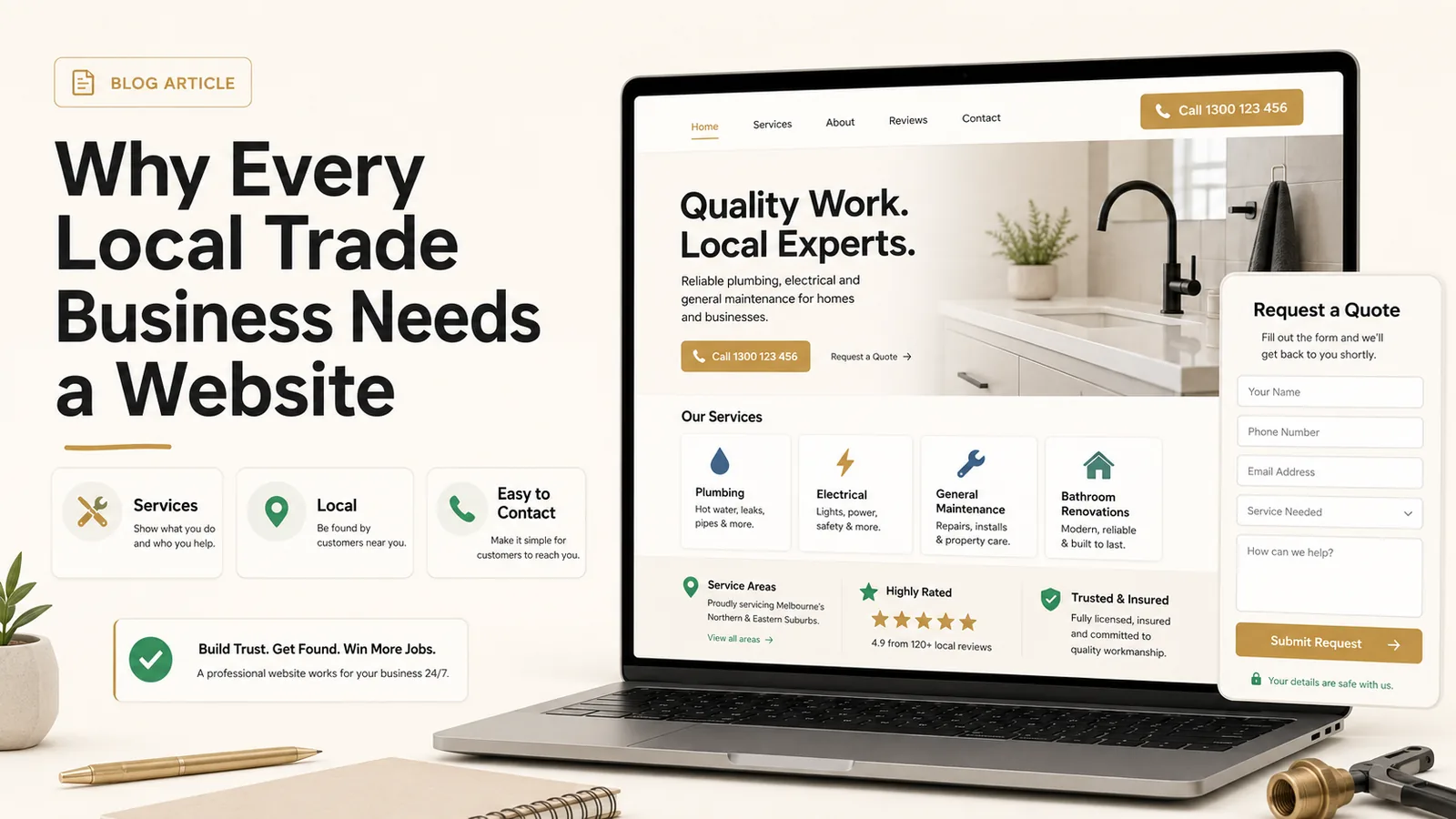
A strong website tells the visitor:
- This business is active and professional.
- The company provides the service I need.
- It works in my area.
- I can call or request a quote easily.
- Other customers have trusted this company.
A weak or outdated website can create the opposite impression. Broken pages, tiny text, old photos, missing service information, or a phone number hidden in the footer may make a reliable company appear less established than it really is.
Your website does not need to be flashy. It needs to make the business feel trustworthy and easy to hire.
Customers want answers quickly
People looking for a trade professional are usually trying to solve a specific problem. They may have no heat, a leaking pipe, an electrical issue, roof damage, or a remodeling project they want priced.
They are not visiting your website for entertainment. They want fast answers.
A useful trade website should make it easy to understand:
- What services you provide
- Which locations you serve
- Whether you handle emergency work
- How to contact you
- What makes your company different
- Whether you are licensed, insured, or certified where applicable
- What previous work looks like
- What customers say about the experience
The easier this information is to find, the less likely the visitor is to leave and call a competitor.
A website gives you control over your message
Social media profiles and directory listings are useful, but they limit how your business is presented. You do not control the layout, the surrounding advertisements, the order of information, or the platform’s future rules.
Your own website gives you a place to explain your business clearly.
You can create a separate page for each major service, show your service area, display project photos, answer common questions, explain your process, and direct customers toward the action you want them to take.
For example, a plumbing company can create dedicated pages for drain cleaning, water heater repair, leak detection, sewer line repair, and emergency plumbing. Those pages are more useful to customers than one generic paragraph saying the company “handles all plumbing needs.”
A website supports local search visibility
A website gives search engines more information about your business.
A well-structured site can include pages focused on the services and locations you actually serve. That makes it easier for search engines to understand the business and match it with relevant local searches.
A contractor who serves Edison, Piscataway, and Woodbridge can describe those service areas naturally throughout the site. An HVAC company can create useful pages about furnace repair, AC replacement, maintenance, and emergency service.
This does not guarantee a particular ranking. Local competition, reviews, business history, content quality, and many other factors matter. But without a useful website, your business has fewer opportunities to appear for the services customers are actively searching for.
A website works even when you are on the job
Trade professionals cannot answer every call immediately. You may be driving, working in a crawlspace, meeting with a customer, or managing a crew.
A website continues explaining the business while you are unavailable.
It can show the visitor that you handle their type of project, answer basic questions, collect a quote request, provide business hours, display emergency contact instructions, and set expectations for the next step.
A short, well-designed form can capture the customer’s name, phone number, and requested service. That gives you enough information to follow up without forcing the customer through a long questionnaire.
A professional website builds trust
Hiring a trade professional often involves letting someone into a home or approving work that may cost thousands of dollars. Customers want reassurance.
A website can provide that reassurance through clear company information, real project photos, selected customer reviews, accurate credentials, and professional design.
Explain who owns the business, how long it has operated, and what kind of work the team specializes in. Show completed work where possible. Display licenses, certifications, insurance information, warranties, financing options, or workmanship guarantees accurately and without exaggeration.
A clean layout, readable text, strong mobile experience, and consistent branding show attention to detail.
A website can improve lead quality
A website should not only generate more inquiries. It should help generate better inquiries.
Clear service pages help customers determine whether your company is a good fit before calling. A project gallery can set expectations about the type and scale of work you perform. A service-area section can reduce inquiries from locations you do not cover.
You can also explain whether you provide free or paid estimates, whether you handle residential or commercial work, whether emergency service is available, whether you take small repair jobs, and whether financing is offered.
This information saves time for both the customer and your team.
A website supports every other marketing channel
A professional website makes other marketing efforts more effective.
Your Google Business Profile can link to it. Social posts can send visitors to a service page. Printed flyers can include the web address. Truck graphics can direct people to a simple domain. Referral partners can share a link instead of trying to explain your services.
The website becomes the central place where interested customers can learn more and take action.
What a local trade website should include
A practical starter website usually needs:
- A clear homepage
- An about page
- A main services page
- Individual pages for important services
- Service-area information
- Reviews or testimonials
- Project photos or a gallery
- Frequently asked questions
- A contact or quote-request page
- Tap-to-call phone links
- Mobile-friendly layouts
The exact structure depends on the business. A one-person repair company may need a focused five-page site. A larger contractor with several service categories and locations may need a deeper structure.
The goal is not to create as many pages as possible. The goal is to create the pages customers need.
The bottom line
A local trade business may survive without a website, especially when referrals are strong. But relying only on referrals, social media, or directory listings makes it harder to control how the business is presented and harder for new customers to learn why they should call.
A professional website helps a trade business look established, explain its services, support local search visibility, and turn interest into calls and quote requests.
It should reflect the quality of the work you already do.
Ready for a website that helps customers call with confidence?
Pak Tech Solutions builds clear, mobile-friendly websites for plumbers, electricians, HVAC companies, contractors, and other local service businesses. We focus on the information customers care about most: services, service areas, trust, and an easy next step.