
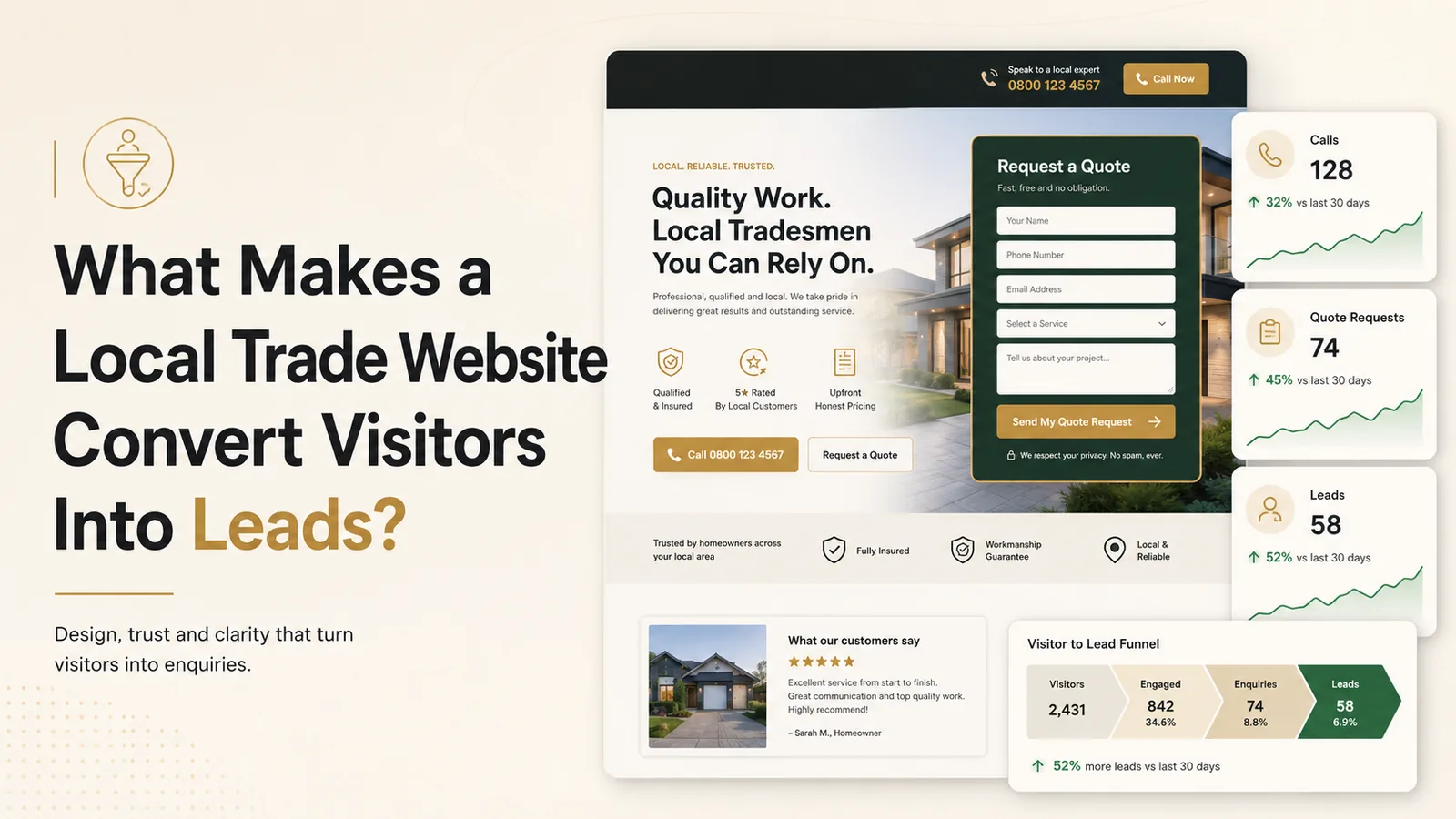
A website conversion happens when a visitor takes a useful action.
For a local trade business, that may be:
- Calling
- Requesting an estimate
- Booking service
- Submitting a form
- Asking about financing
- Visiting a location
- Requesting emergency help
More traffic can create more opportunities, but traffic alone is not enough.
The website must make the business clear, credible, and easy to contact.
Start with the visitor’s intent
A plumbing customer searching for a clogged drain has a different goal from a homeowner researching a kitchen remodel.
The website should match the visitor’s urgency and decision process.
Urgent service visitors need:
- Immediate confirmation
- Visible phone number
- Service-area information
- Emergency availability
- Fast mobile loading
Estimate visitors need:
- Detailed service information
- Project examples
- Reviews
- Process
- Financing
- Easy estimate request
High-value project visitors need:
- Case studies
- Credentials
- Team information
- Clear expectations
- Professional presentation
Conversion begins with understanding the reason for the visit.
Use a specific headline
A homepage headline should explain what the company does and where it works.
Weak:
Quality service you can trust.
Stronger:
Residential plumbing repair and water heater service in Central New Jersey.
The stronger version answers real questions.
Brand language can support the message, but it should not replace clarity.
Show important services above the fold
Customers should not have to scroll through a large photo and several paragraphs before seeing services.
Feature the services that drive the business.
A roofer may show:
- Roof repair
- Roof replacement
- Storm damage
- Commercial roofing
An electrician may show:
- Electrical repair
- Panel upgrades
- EV chargers
- Generators
Each service should link to a dedicated page when appropriate.
Make calls to action obvious
A call to action tells the visitor what to do next.
Examples:
- Call for service
- Request an estimate
- Schedule an appointment
- Get a quote
- View our work
- Ask about financing
Use one primary action and one secondary action in important sections.
Do not place several competing buttons with unclear priorities.
Reduce form friction
The form should match the service.
An emergency repair form may need only:
- Name
- Phone
- Service needed
A remodeling form may reasonably ask for:
- Name
- Phone
- Project type
- Town
- Timeline
- Short description
Every required field should have a purpose.
Long forms can qualify leads, but they can also discourage good customers. Balance matters.
Place trust near the action
Trust signals should appear close to call and form buttons.
Examples:
- Licensed and insured
- Years in business
- Review rating
- Workmanship guarantee
- Financing available
- Background-checked technicians
- Local and family-owned
- Warranty support
Only use claims the business can support.
Trust should not be hidden on the about page.
Use real proof
Real proof converts better than generic promises.
Strong proof includes:
- Project photos
- Customer reviews
- Before-and-after images
- Case studies
- Team photos
- Vehicles
- Credentials
- Project counts
- Years in business
Do not fabricate customer names, projects, or ratings.
When a business is new, focus on real experience, founder background, process, and honest guarantees instead of invented proof.
Explain the process
Customers hesitate when they do not know what happens after contact.
A simple process can reduce uncertainty:
- Submit a request.
- We confirm the project details.
- We schedule a visit.
- You receive clear recommendations or a proposal.
- Work is scheduled after approval.
The process should reflect reality.
Improve mobile performance
Many visitors will never see the desktop version.
Mobile conversion depends on:
- Fast loading
- Readable text
- Tap-to-call links
- Simple navigation
- Large buttons
- Forms that fit the screen
- No overlapping widgets
- No intrusive popups
Test the site on actual phones, not only in a desktop preview.
Write for scanning
Customers rarely read every word.
Use:
- Descriptive headings
- Short paragraphs
- Bullet lists
- Service cards
- Bold emphasis
- Clear section labels
- Simple language
Avoid long blocks of generic copy.
The page should reveal the main message even when the visitor scans.
Answer objections
Customers may hesitate because of cost, timing, trust, or process.
Address common questions:
- Do you provide estimates?
- Do you serve my town?
- Are you licensed?
- Do you handle permits?
- Do you offer financing?
- Do you provide warranties?
- How quickly can you schedule?
- Do you handle emergency calls?
- What type of work do you not accept?
Clear answers help qualified customers move forward.
Create focused service pages
A dedicated service page can convert better than a general homepage because it matches the visitor’s search.
A strong service page includes:
- Clear service headline
- Common problems or goals
- What the service includes
- Why choose the company
- Service area
- Related reviews
- Frequently asked questions
- Call and form action
Do not duplicate the same template text without adapting it to the service.
Use visual hierarchy
The design should show what matters most.
Large headline. Clear services. Visible phone button. Trust signals. Proof. Action.
Avoid giving every element the same size and color.
Good hierarchy guides the eye.
Track conversion events
Measure:
- Phone clicks
- Form submissions
- Booking clicks
- Financing clicks
- Email clicks
- Direction requests
- Chat starts
- Key page visits
Without tracking, it is difficult to know whether redesign or marketing changes are working.
Review conversion by device. A site may perform well on desktop and poorly on mobile.
Improve one problem at a time
Conversion optimization does not require constant redesign.
Test practical changes such as:
- Shorter form
- Clearer headline
- Larger phone button
- Better service order
- Stronger project photos
- More relevant review
- Faster page
- Clearer service area
Use data and customer feedback.
The bottom line
A trade website converts when it answers the customer’s questions and makes the next step feel safe and simple.
The essentials are:
- Clear services
- Local relevance
- Strong proof
- Visible contact options
- Short forms
- Mobile usability
- Fast performance
- Honest expectations
Conversion-focused design is not about pressure. It is about removing uncertainty.
Turn more website visits into real local inquiries
Pak Tech Solutions builds conversion-focused websites for local trade businesses. We organize services, trust signals, proof, forms, and mobile calls to action around the way customers actually choose a provider.