
Local contractors often ask whether they really need a website when they already have a Facebook page, Instagram account, or Google Business Profile.
Those platforms are valuable. They can help you share project photos, collect reviews, appear on maps, and stay visible in the community. But they solve a different problem than a website.
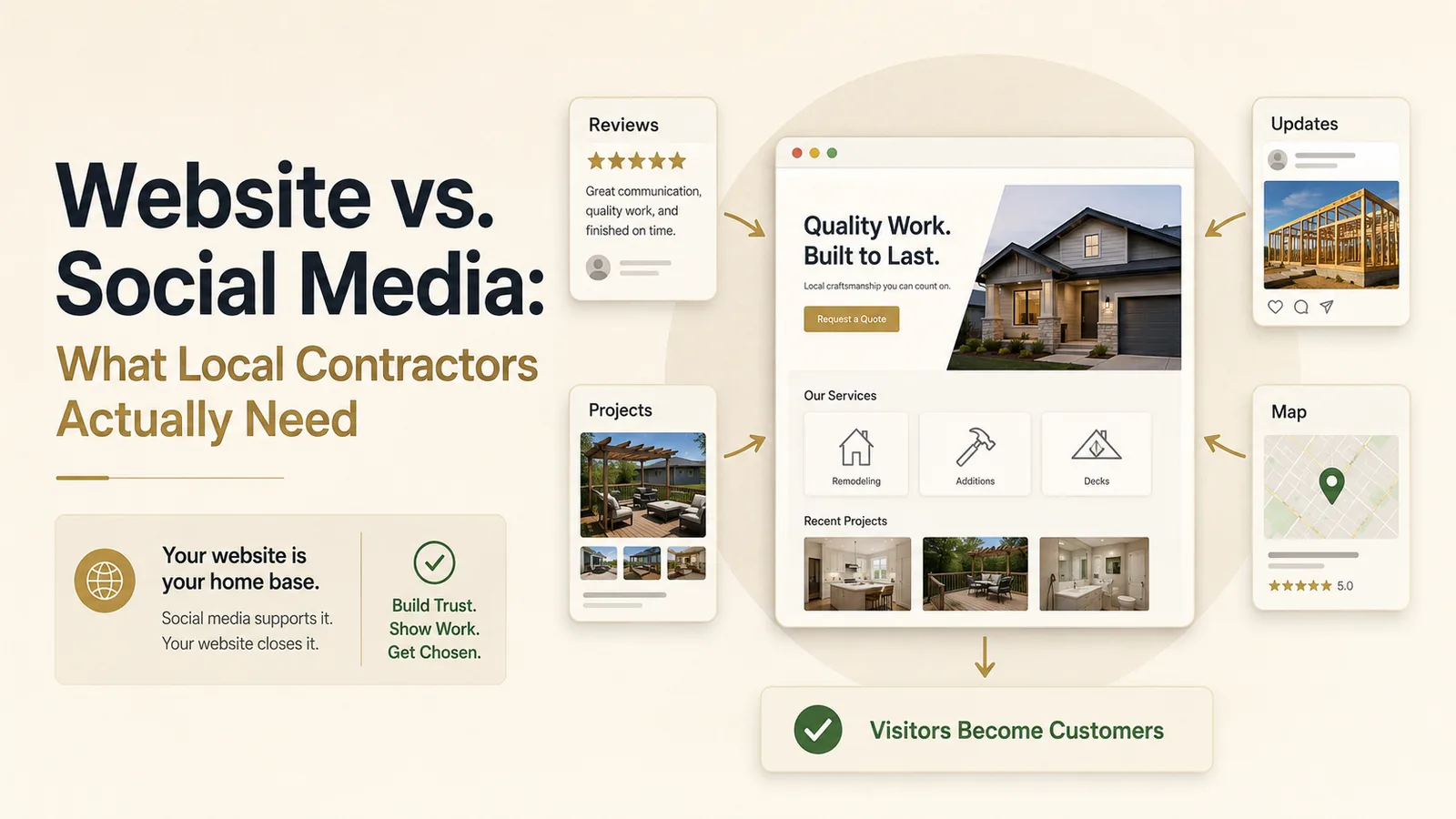
Social platforms help people discover and follow your business. A website helps them evaluate and hire it.
For most local trade companies, the strongest setup is not a website or social media. It is a professional website supported by the platforms customers already use.
Social media is rented space
When you build a presence on Facebook, Instagram, TikTok, or another platform, you are operating inside someone else’s system.
The platform controls how your page is displayed, which followers see your posts, what advertisements appear nearby, which features remain available, whether your account is restricted, and how customer information is collected.
You can invest years into a social profile and still have limited control over how customers move from interest to contact.
A website is different. You control the domain, layout, service information, navigation, calls to action, and overall customer experience. That ownership matters because your website can serve as the permanent center of your online presence.
Social feeds are not organized around customer questions
A homeowner researching a contractor usually wants specific information.
They may want to know:
- Do you provide the service I need?
- Do you serve my town?
- Are you licensed and insured?
- Can I see similar work?
- How do I request an estimate?
- Do you offer emergency service?
- What do customers say about you?
On social media, that information may be scattered across posts, captions, comments, profile details, and photo albums.
A website organizes it into clear pages.
A roofing company can have separate pages for roof repair, replacement, storm damage, and commercial roofing. A general contractor can show kitchens, bathrooms, additions, and finished basements. An electrician can explain panel upgrades, EV chargers, generators, and troubleshooting.
That structure helps customers find the answer they need without scrolling through months of posts.
Social media is still useful for proof and personality
A website does not replace social media.
Social platforms are strong places to show recent project photos, work in progress, before-and-after transformations, team members, community involvement, seasonal reminders, short educational tips, customer reviews, and business updates.
These posts make the company feel active and real.
The best strategy is to use social media to create attention and use the website to convert that attention into action.
A social post about a finished bathroom can link to a remodeling service page. A short video about a common electrical issue can send viewers to an electrical repair page. A storm-preparation post can link to a roofing inspection page.
Google Business Profile is important, but it is not a full website
A Google Business Profile can be one of the most valuable online assets for a local trade business. It can show your business in map results, display reviews, provide hours, and give customers a call button.
However, it has limitations.
A profile cannot explain every service in depth. It does not give you full control over layout or branding. It may show competitors nearby. It can also contain information submitted or suggested by users.
Your website complements the profile by giving interested customers a place to learn more.
A strong profile may earn the click. The website helps earn the call.
A website supports local search in more ways
A website allows you to create pages focused on specific services and relevant locations.
For example, an HVAC company may have pages for AC repair, furnace repair, system replacement, ductless mini-splits, seasonal maintenance, and emergency HVAC service.
A social profile cannot provide the same depth or structure.
These pages help search engines understand the business, and they help customers land directly on information that matches their search.
This does not mean creating dozens of thin pages with the same copy. The content should be useful, accurate, and specific to the service.
A website makes advertising more effective
Paid advertising becomes more useful when the click leads to a focused page.
Imagine running an ad for water heater replacement. Sending that traffic to a general Facebook page forces the customer to search for information. Sending it to a dedicated water heater page allows you to explain types of systems installed, signs replacement may be needed, service area, financing availability, the installation process, and how to request an estimate.
The page can be designed around one action: call or request a quote.
That creates a clearer path than sending every customer to the same social profile.
A website helps you look established
Customers compare businesses quickly.
One company may have only a social page with scattered information. Another may have a professional website with clear services, reviews, project examples, and a visible phone number.
Even when both companies perform excellent work, the second often looks more prepared and easier to trust.
This is especially important for higher-value projects such as roof replacement, electrical service upgrades, HVAC replacement, kitchen remodeling, bathroom remodeling, additions, and commercial work.
Social media reach can change
A business may have thousands of followers and still reach only a small percentage of them with each post. Platform algorithms, content trends, and advertising priorities change over time.
A website is more stable.
You still need to maintain it, improve it, and promote it. But a customer can visit the same domain directly, bookmark it, share it, or find it through search.
The website is not dependent on a feed deciding whether to show your latest post.
The ideal setup for a local contractor
A practical online presence can include:
Website
Use it for service information, service areas, project galleries, reviews, company details, and lead generation.
Google Business Profile
Use it for map visibility, reviews, hours, photos, updates, and direct calls.
Use it for local community visibility, project updates, referrals, and conversations.
Use it for visual proof, before-and-after work, team content, and short project stories.
Email or text follow-up
Use it to respond to inquiries and stay in contact with previous customers.
Each channel has a role. The website connects them.
What if most of your work comes from referrals?
Referral-heavy businesses still benefit from a website.
A referred customer often searches the company name before calling. They want confirmation that the business is real, active, and qualified.
The website supports the referral by giving the customer confidence.
It can also help the person making the referral. Sharing a website link is easier than explaining every service, location, and contact detail.
The bottom line
Social media and Google Business Profile are valuable, but they should not carry the entire weight of your online presence.
They are discovery and engagement tools.
Your website is the place where customers can understand the business, compare services, view proof, and take the next step.
Local contractors usually do not need to choose between a website and social media. They need both working together.
Build the central hub for your local marketing
Pak Tech Solutions creates professional websites for contractors and local trade businesses. We build mobile-friendly service pages, clear calls to action, and practical layouts that make it easier for customers to understand what you do and contact you.