
A plumbing customer rarely visits a website casually.
They may have water leaking under a sink, a clogged drain, no hot water, a failed sump pump, or a larger project that needs an estimate. They want to know whether the company can help, whether it serves their area, and how quickly they can make contact.
That means a plumbing website has a simple job:
Help the right customer call or request service with as little friction as possible.
A beautiful website that hides the phone number, buries the services, or loads poorly on mobile is not doing that job.
Put the phone number where customers can see it
The most important phone number on a plumbing website should not be hidden in the footer.
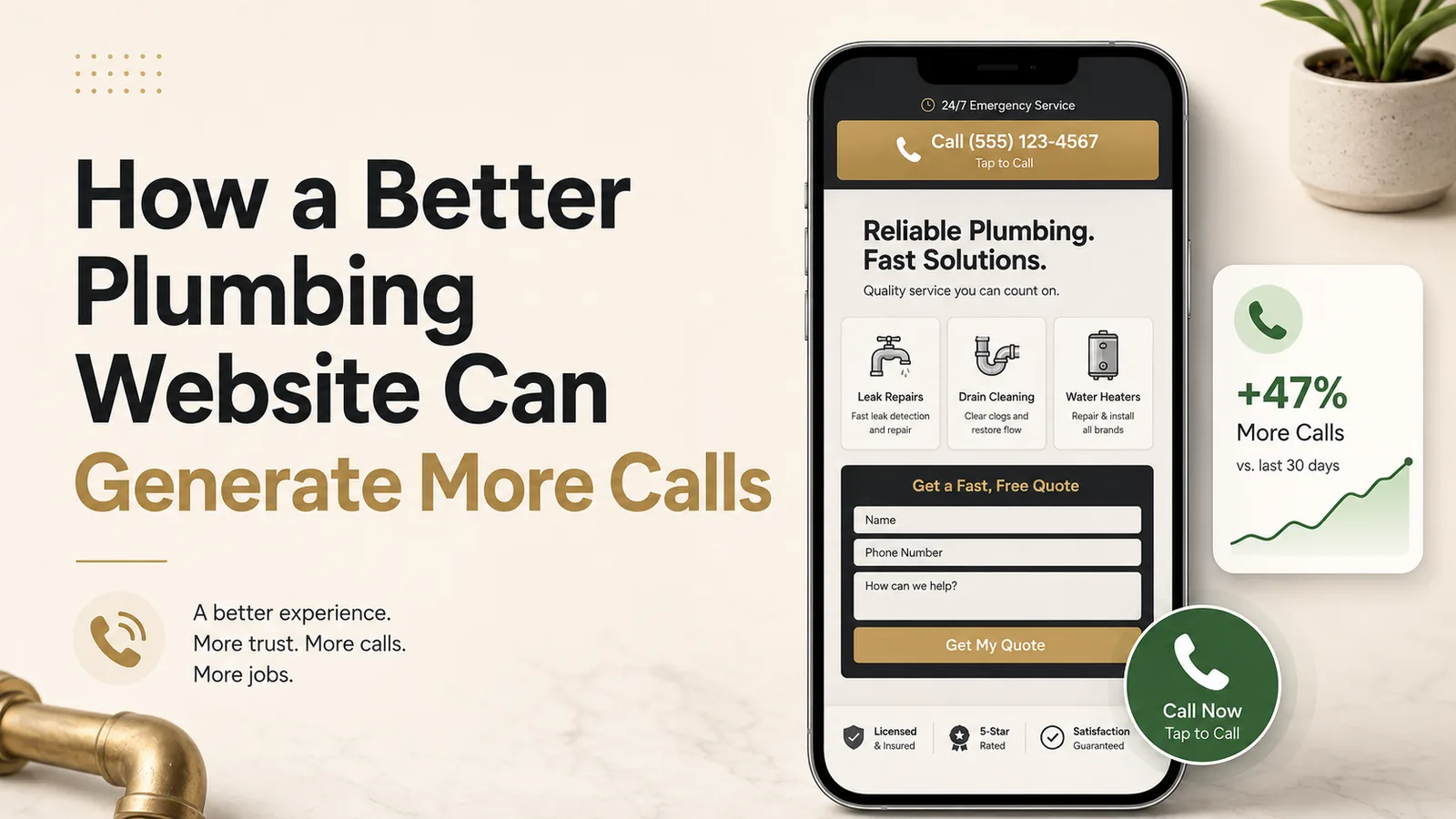
It should appear prominently in the header and be clickable on mobile devices.
A visitor should not have to scroll, open several menus, or search the contact page just to call.
For emergency plumbing companies, the call action should be especially clear. The site can distinguish between normal estimate requests and urgent service without creating confusion.
Good examples of call-to-action text include:
- Call for plumbing service
- Request an estimate
- Schedule service
- Emergency service available
- Tap to call now
The wording should match what the business actually offers.
Lead with the services customers search for
Many plumbing websites begin with vague statements such as “quality service you can trust.” That message may be true, but it does not immediately answer the customer’s question.
A stronger homepage leads with actual services.
For example:
- Drain cleaning
- Water heater repair
- Leak detection
- Sewer line repair
- Fixture installation
- Emergency plumbing
These services can appear as clear cards or links near the top of the page.
The visitor can quickly confirm that the company handles the problem. Search engines also receive clearer information about the business.
Create dedicated service pages
A single paragraph listing every plumbing service is not enough for customers who want details.
Important services deserve their own pages.
A useful water heater page might explain repair versus replacement, tank and tankless options, common warning signs, service area, installation process, financing availability, and how to request an estimate.
A drain cleaning page can discuss slow drains, recurring clogs, camera inspections, and when professional service may be needed.
Each page should be written for customers, not just search engines.
Make service areas obvious
Local customers want confirmation that you serve their town.
A service-area section should appear on the homepage and contact page. Important towns can also be mentioned naturally on relevant service pages.
Avoid creating dozens of identical city pages with only the town name changed. Useful location pages should contain real information about the area, the services commonly provided there, and how the company works locally.
The goal is clarity and relevance, not page count.
Use a short quote or service form
Long forms create friction.
A customer with an urgent plumbing problem usually does not want to complete nine required fields before making contact.
A short form can ask for:
- Name
- Phone number
- Service needed
You can collect the remaining details during follow-up.
For non-urgent project requests, an optional message field or photo upload can be useful. But the required path should remain simple.
Design for mobile first
Many plumbing searches happen on phones.
The website should be easy to use with one hand and under stress.
That means:
- Large, readable text
- Tap-to-call phone buttons
- Simple navigation
- Short forms
- Clear service links
- Fast-loading images
- Buttons with enough spacing
- No intrusive popups covering the screen
A desktop layout squeezed onto a phone is not a mobile experience.
Show trust immediately
Plumbing customers often need to let a technician into their home. Trust matters.
The website should include accurate trust signals such as licensing and insurance where applicable, years in business, background-checked technicians if true, satisfaction or workmanship guarantees, financing options, review ratings, memberships, certifications, and real team or vehicle photos.
Avoid creating fake review counts, fake awards, or vague badges that do not represent real credentials.
Feature customer reviews strategically
Reviews should support the services customers care about.
Instead of displaying only generic praise, choose testimonials that mention fast response, clear communication, clean work, fair pricing, emergency service, water heater replacement, drain repair, or respect for the home.
A short quote near a relevant service can be more persuasive than a long review page that nobody visits.
The website can also link to the company’s public review profiles.
Use real project and team photos
Plumbing is not always visually glamorous, but real photos still build trust.
Useful images include branded service vehicles, technicians at work, water heater installations, finished fixture replacements, sewer or excavation equipment, clean mechanical rooms, team photos, and before-and-after examples.
Authentic photos help customers recognize the company and understand the work.
Explain what happens after contact
Customers are more likely to submit a request when they understand the next step.
A simple process can be shown as:
- Call or submit the form.
- We confirm the issue and location.
- We schedule service or an estimate.
- A technician arrives and reviews the work.
- You receive clear options before work begins.
The exact process should match the company’s real workflow.
This kind of clarity reduces uncertainty.
Improve page speed
A plumbing website should not make a customer wait while large videos, oversized photos, and unnecessary animations load.
Performance can be improved through proper image sizing, modern image formats, limited third-party scripts, efficient hosting, clean page structure, careful use of animation, and ongoing maintenance.
Page speed is especially important for mobile visitors on weak connections.
Track the actions that matter
Website traffic alone does not tell you whether the site is working.
Track actions such as phone-number clicks, form submissions, appointment bookings, emergency-service clicks, direction requests, and visits to key service pages.
This information helps you understand which pages create real opportunities.
It also helps identify problems. If many visitors reach the contact page but few submit the form, the form may be too long or confusing.
Match the website to the plumbing company
A one-person residential plumber needs a different website from a multi-location company with dispatching and commercial contracts.
The website should reflect team size, service area, emergency availability, residential or commercial focus, specialty services, scheduling process, and brand personality.
The best plumbing website is not the one with the most features. It is the one that makes the company easy to understand and hire.
Common plumbing website mistakes
Watch for these problems:
- Phone number only in the footer
- No tap-to-call button
- One vague services paragraph
- No service-area information
- Long required forms
- Tiny mobile text
- Slow-loading hero videos
- Stock photos that do not resemble the company
- Outdated hours or contact details
- Broken forms
- No reviews or proof
- No explanation of emergency service
Each issue creates another reason for the customer to leave.
The bottom line
A plumbing website generates more calls when it reduces uncertainty.
Customers should quickly understand what the company does, where it works, why it is trustworthy, and how to contact it.
The website should not force the visitor to study the business. It should guide the visitor toward the right next step.
Turn more plumbing searches into service calls
Pak Tech Solutions designs fast, mobile-friendly plumbing websites with clear service pages, tap-to-call actions, service-area content, reviews, and simple quote forms.