
Homeowners do not choose a contractor based only on price.
They also consider trust, communication, experience, professionalism, and whether the company seems capable of completing the work correctly.
Much of that evaluation begins before the first phone call.
A customer may receive your name from a friend, see your truck, find you on Google, or discover a project photo on social media. The website becomes the place where they decide whether to take the next step.
A strong contractor website reduces uncertainty.
Customers are trying to manage risk
Hiring a contractor can involve a significant financial commitment, disruption inside the home, permit and inspection requirements, scheduling uncertainty, material decisions, access to private property, concerns about quality, and concerns about unfinished work.
The customer wants evidence that the company is organized and dependable.
Your website cannot prove everything, but it can show that the business communicates clearly and has a repeatable process.
Start with a clear description of the work
Do not make customers guess what kind of contractor you are.
A general contractor may focus on kitchens, bathrooms, basements, additions, whole-home remodeling, exterior renovations, or commercial build-outs.
A roofing company may focus on repairs, replacements, storm damage, and flat roofing.
A clear homepage headline and service list help the right customer self-qualify.
Use real project photography
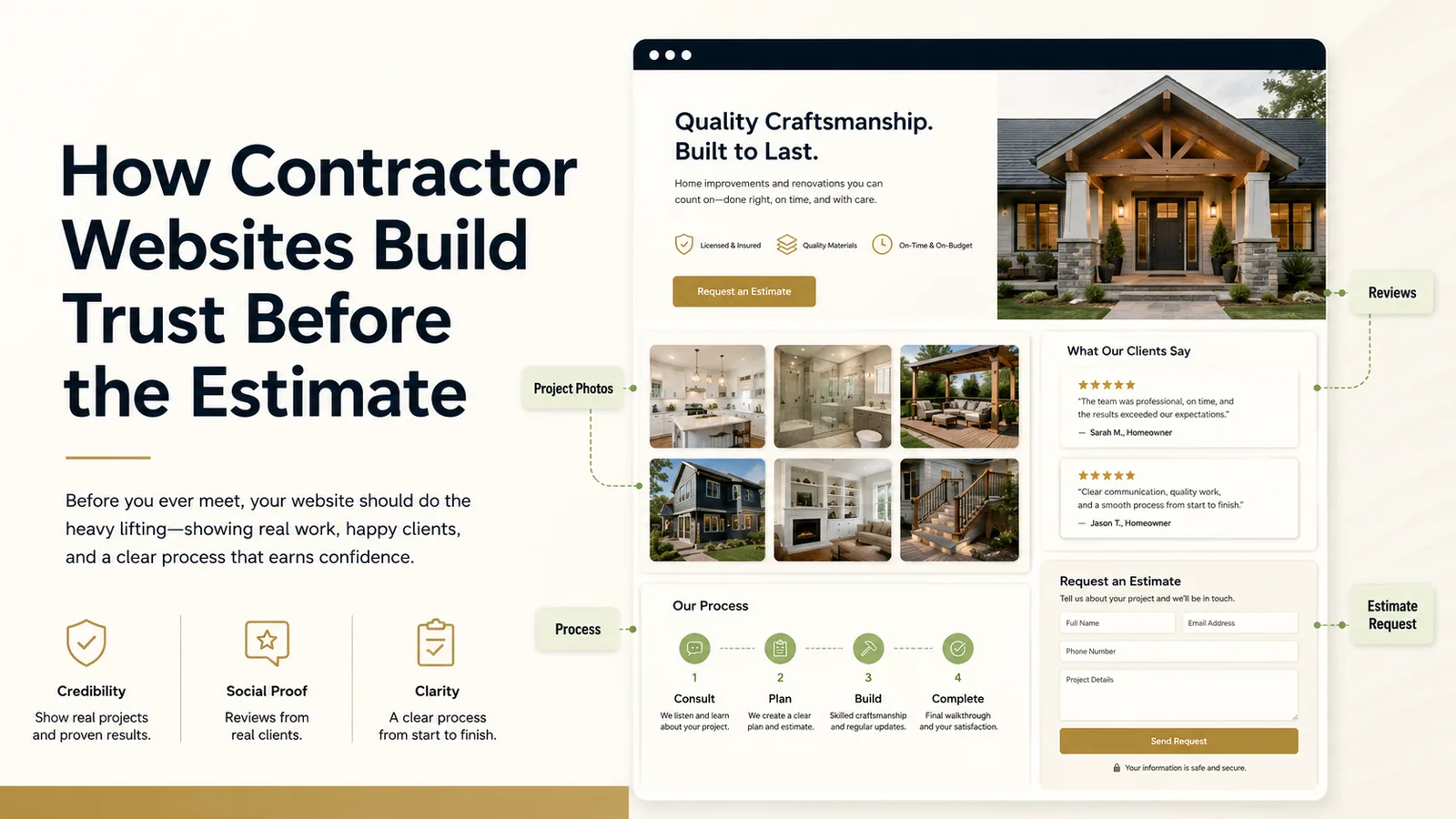
Project photos are among the strongest trust signals for contractors.
They show that the company has completed work similar to what the customer wants.
Useful project photos should be real, well lit, high resolution, organized by service, consistent in presentation, and supported by short descriptions.
For larger projects, create case studies that explain:
- The customer’s goal
- The challenge
- The work performed
- Materials or features
- Timeline
- Final result
Do not claim fictional projects or use stock photos as if they are completed work.
Explain your process
Homeowners often worry about what happens after they request an estimate.
A simple process section can include:
- Initial conversation
- Site visit
- Scope and proposal
- Scheduling
- Construction
- Final walkthrough
The details should reflect how the company actually operates.
This helps the customer understand that the project will be managed, not improvised.
Show who is behind the business
An about page should do more than repeat marketing language.
Introduce the owner, team, years of experience, areas of specialization, company values, local ties, why the business was started, and what customers can expect.
Real team photos are especially valuable.
Customers want to know who may enter their home and who will be responsible for the project.
Display credentials accurately
Depending on the trade and location, the website may include license information, insurance, certifications, manufacturer credentials, trade memberships, warranty information, and permit experience.
Accuracy matters.
Do not imply a certification or guarantee that the business cannot support.
Use reviews to answer common concerns
Choose reviews that address the issues customers worry about:
- Did the contractor communicate?
- Did the crew arrive when expected?
- Was the jobsite kept clean?
- Did the company explain changes?
- Was the project completed properly?
- Did the final result match expectations?
- Were problems handled professionally?
A review that says “great work” is helpful. A review that describes the actual experience is more persuasive.
Explain what makes your company different
Avoid unsupported claims such as “the best contractor in New Jersey.”
Instead, describe concrete differences.
Examples:
- One point of contact throughout the project
- Detailed written proposals
- Clean-jobsite procedures
- Background-checked employees
- Specialized experience
- Design-build capability
- Transparent change-order process
- Warranty support
- Local supplier relationships
Specific information is more credible than broad superlatives.
Make pricing expectations clearer
Many contractors cannot provide exact pricing without seeing the project.
That does not mean the website must avoid the topic entirely.
You can explain what affects price, whether estimates are free or paid, typical project minimums, whether financing is available, when deposits are required, how change orders are handled, and what is included in the proposal.
Transparency helps reduce mismatched leads.
Make it easy to request the right type of estimate
A form can collect basic information such as name, phone, email, project type, town, desired timeline, and a short project description.
For larger remodeling projects, a slightly more detailed form may be appropriate. But it should still feel manageable on mobile.
The form should also explain what happens next.
Show service areas clearly
Contractors often waste time responding to inquiries outside their working radius.
A clear service-area page helps.
List the towns, counties, or region served. Mention any limitations honestly.
For example:
- Residential remodeling throughout Middlesex County
- Roofing projects within 30 miles of Edison
- Commercial work considered throughout Central New Jersey
Clear geography improves lead quality.
Maintain the website
A neglected website can reduce trust.
Update project photos, team members, phone numbers, hours, services, certifications, financing details, reviews, forms, and copyright dates.
A website that still mentions discontinued services or outdated staff creates doubt.
Match the design to the project value
A contractor asking customers to trust them with a major renovation should not have a website that feels careless.
The design should be clean, readable, mobile-friendly, consistent, fast, easy to navigate, and focused on proof.
The website does not need expensive effects. It needs attention to detail.
The website should prepare the customer for the conversation
A good website makes the first call more productive.
The customer already understands what you do, where you work, what the process looks like, what kind of projects you accept, why the company appears trustworthy, and how to request an estimate.
That allows the conversation to focus on the project rather than basic clarification.
The bottom line
Trust begins before the estimate.
A contractor website builds trust by showing real work, introducing the people behind the business, explaining the process, displaying accurate credentials, and setting clear expectations.
The goal is not to impress every visitor. It is to help the right customer feel confident enough to contact you.
Present your contracting business with the credibility it deserves
Pak Tech Solutions designs professional websites for general contractors, remodelers, roofers, and other local trades. We organize project galleries, service pages, reviews, and estimate requests into a clear customer experience.