
An electrician’s website should do more than display a logo and phone number.
Electrical work involves safety, trust, and technical expertise. Customers want to know whether the company handles their problem, serves their location, and appears qualified to perform the work.
A strong electrician website answers those questions quickly and guides the visitor toward a call or estimate request.
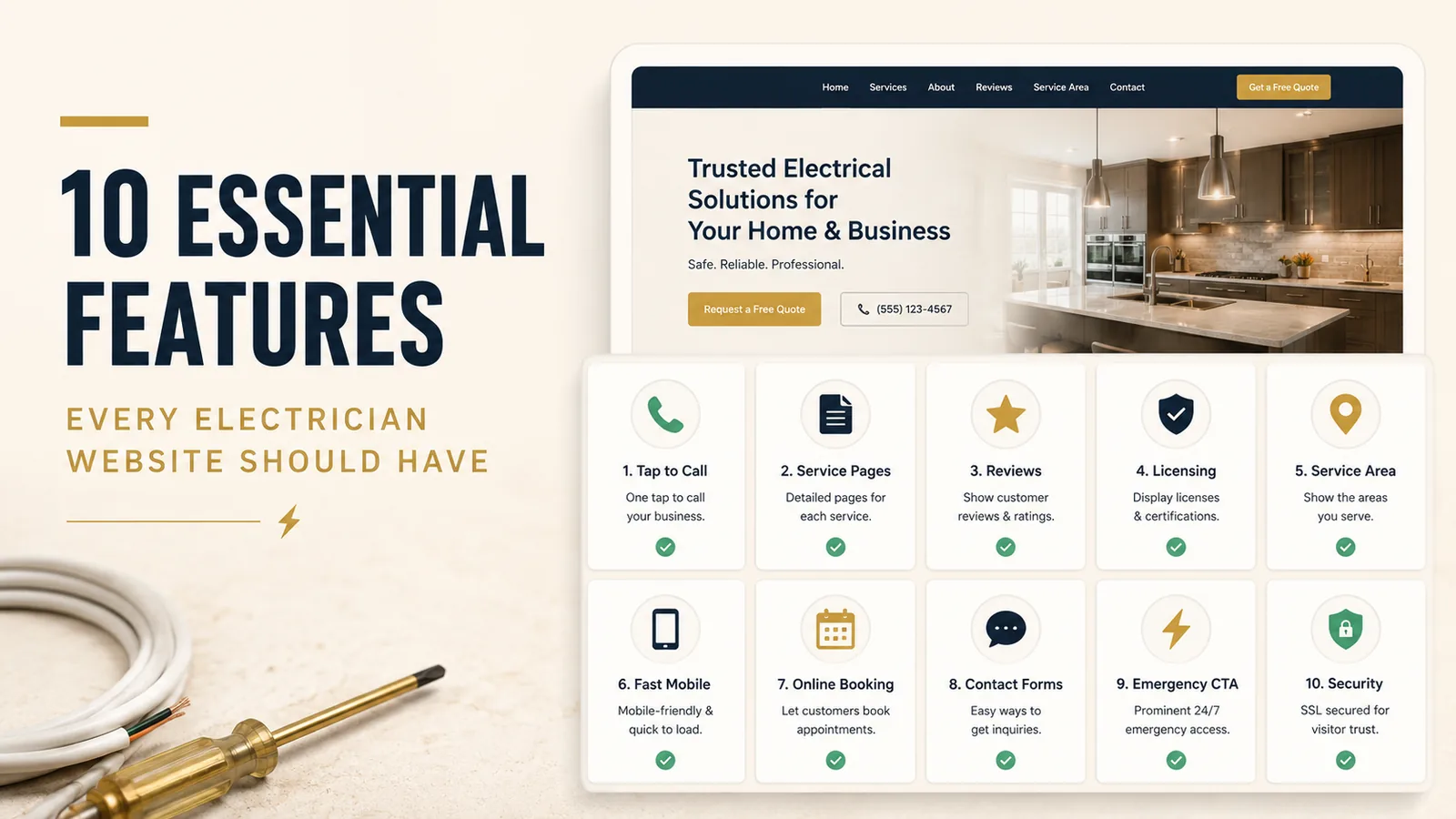
Here are ten features that matter most.
1. A clear service headline
The homepage should immediately identify the company as an electrician and explain the primary market.
Examples:
- Residential electrical services in Central New Jersey
- Licensed electricians for homes and small businesses
- Electrical repairs, panel upgrades, and EV charger installation
Avoid relying only on generic phrases such as “powering your future.” A customer should understand the service within seconds.
2. Tap-to-call contact information
The phone number should appear prominently in the header and remain easy to access throughout the site.
On mobile, it should be clickable.
Customers may be dealing with power loss, burning smells, tripped breakers, sparking outlets, failed equipment, or an urgent inspection issue.
They should not have to search for contact information.
3. Individual service pages
Electrical companies often provide a wide range of services. Separate pages help customers find relevant information.
Important pages may include:
- Electrical repairs
- Panel upgrades
- Service changes
- EV charger installation
- Generator installation
- Lighting installation
- Outlet and switch replacement
- Surge protection
- Commercial electrical work
- Electrical inspections
Each page should explain the service, common reasons customers request it, and how to schedule an estimate.
4. Accurate license and insurance information
Customers want reassurance that they are hiring a legitimate professional.
Display accurate credentials where appropriate, including electrical license information, insurance status, certifications, manufacturer training, professional memberships, and permit experience.
Do not use vague badges that imply credentials the company does not hold.
A short explanation of why licensing and proper permits matter can also educate the customer.
5. Service-area information
The website should make the geographic area clear.
Include main cities or towns served, county or regional coverage, residential and commercial availability, travel limitations, and emergency coverage if offered.
Service-area details help customers decide whether to contact the company and help search engines understand local relevance.
6. Reviews that mention the real experience
Reviews are strongest when they describe what customers value.
Look for feedback about professional communication, arriving on time, clean work, clear explanations, safe solutions, fair estimates, successful troubleshooting, and respect for the home.
Place short reviews throughout the website, not only on a separate testimonials page.
7. Real project photos
Electrical work may be hidden behind walls, but there are still many useful photo opportunities.
Examples include clean panel installations, EV chargers, generator setups, lighting projects, service equipment, commercial installations, organized wiring, branded vehicles, and technicians at work.
Real photos show attention to detail and make the business feel established.
8. A simple estimate form
The form should collect enough information to begin the conversation without overwhelming the customer.
A practical form can ask for:
- Name
- Phone number
- Email, if needed
- Service requested
- Short optional message
Additional details can be collected during follow-up.
Long forms can be useful for complex commercial requests, but they should not be the only way to contact the business.
9. Frequently asked questions
Electrical customers often have practical questions before calling.
Useful topics include:
- Do you provide free estimates?
- Do you handle permits?
- Do you install customer-purchased fixtures?
- How long does a panel upgrade take?
- Can you install an EV charger in an attached garage?
- Do you perform troubleshooting?
- Do you offer emergency service?
- Do you work on commercial properties?
FAQs reduce uncertainty and help the customer prepare.
10. Fast, mobile-friendly performance
The website should load quickly and work well on phones.
Important mobile details include readable font sizes, large buttons, tap-to-call actions, simple menus, short paragraphs, properly sized images, forms that fit the screen, no overlapping elements, and no popups blocking the page.
Many electrical searches happen when a customer is standing near the problem. Mobile usability directly affects whether they call.
Additional pages worth considering
Depending on the company, the website may also benefit from:
About page
Explain the company’s background, values, team, and approach.
Financing page
Useful for generators, panel upgrades, rewiring, or larger projects if financing is offered.
Project gallery
Show completed work by service category.
Commercial electrical page
Explain property types, service capacity, maintenance, and response process.
Emergency service page
Clearly explain availability and what customers should do in dangerous situations.
Careers page
Helpful for growing companies that regularly hire electricians and apprentices.
What customers should understand above the fold
The section visible before scrolling should answer four questions:
- What does the company do?
- Where does it work?
- Why should the customer trust it?
- How can the customer make contact?
A practical homepage hero may include a service headline, town or region, phone button, estimate button, license or trust statement, and a short list of major services.
Everything else can follow below.
Avoid common electrician website problems
Common issues include generic stock photos of light bulbs, no service pages, no visible license information, phone number hidden in the footer, outdated project photos, missing service areas, long technical paragraphs, forms with too many required fields, no mobile call button, broken contact forms, and no proof of past work.
These problems make a qualified electrician look harder to hire than necessary.
The website should reflect how you actually work
A residential service electrician should not look like a large industrial contractor if that is not the business.
A generator specialist should feature generators prominently. An electrician focused on new construction should show builder relationships and project capacity. A company serving homeowners should emphasize communication, cleanliness, safety, and scheduling.
The website should match the customer you want to attract.
The bottom line
A strong electrician website combines credibility, clarity, and convenience.
It should explain the services, show proof, display accurate credentials, and make contacting the company simple.
Customers should not have to guess whether you can help.
Build an electrician website that earns trust
Pak Tech Solutions creates professional websites for electricians and other local trades. We focus on mobile usability, clear service pages, visible contact actions, and a structure that helps local customers find the right information quickly.